Vanessa set out on Zambia’s primitive trail to disconnect. What she found instead was unexpected connection.
Read all about her incredible primitive trail experience with Lowveld Trails Co. in the Kafue, Zambia below.
The no-tech nature of the trail means that all Ness has to share with you are her memories and enthusiasm, so the photos in this blog have been kindly shared by Lowveld Trails Co.
Easing into the unknown
It's midday on a Monday and we're being shown our packs and essential kit to keep us alive, safe and comfortable for the next 3 nights in the bush.
Ahead of us is the unknown. Literally and figuratively, for we are about to embark on a primitive trail.
The word primitive means: relating to a very early stage of development, origin, or time, often characterized by simplicity, lack of modern machinery, or an unevolved state {Cambridge Dictionary} and could not be more accurate for what lay ahead.
We are in the southern region of the Kafue National Park, Zambia's largest at 22,400 km², of which approx 4,500 km² are designated wilderness blocks. Which means they will never, by law, be developed with any infrastructure whatsoever – no roads cutting through the landscape, no lodges, no vehicles. Nothing but true, authentic wilderness.
One such section, the Malala Wilderness Area, is to be our stomping ground for the next few days, as we venture on foot, sleeping wild, among the mopane and miombo woodland, traversing the seasonal wetlands and following the river systems as our lifeline.
Our journey started with a night of "classic" safari in a gorgeous little bush camp on the edge of Lake Itezhi-Tezhi. An area akin to Eden. The true luxury here was not seeing a single other vehicle – a rarity in any national park these days, especially for our sunset wild dog sighting. But more on that another time, this notebook entry is about what happened next.
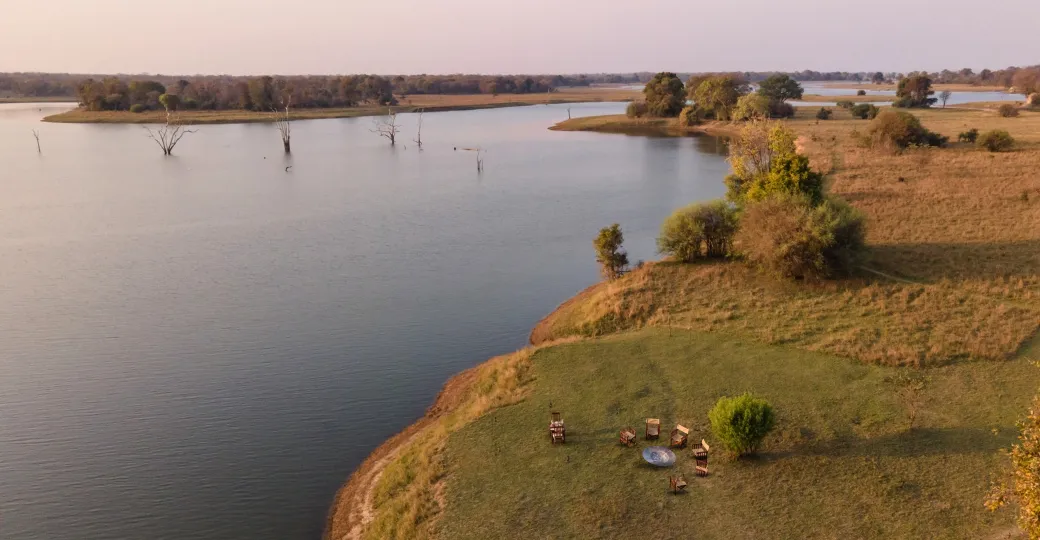
Enjoying a cuppa beside Lake Itezhi-Tezhi at sunrise.
Time to crack on!
Having eased in with a couple of game drives, it was time to shift into primitive mode. Each of us was to carry our own kit in a 10–15 kg backpack – no room for niceties, it's practical kit only. One set of clothes for walking, one set for sleeping in. An inflatable mattress, ground sheet and bivouac bag being our "accommodation".
Ration packs were distributed: 3 dehydrated packets of "dinner", 3 packets of breakfast and 2 lots of lunches. A handful of snacks and a camping stove.
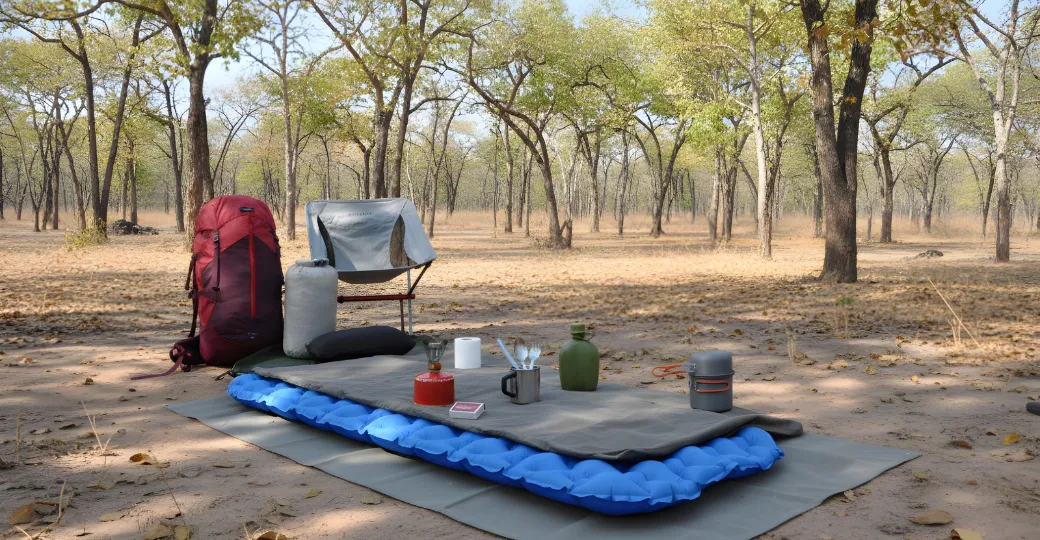
Just the bare necessities!
Phones, watches and any kind of tech was left behind; this was going to be about disconnection. What I didn't anticipate was that it's actually all about connection.
Off we set, led up front by Crispin – a Zambian Wildlife Police Officer – and our guide Brenden, who is one half of Lowveld Trails Co. and the imagination behind this whole endeavour. We are a team of 4 motley crew – 1 Brit, 1 German, 2 Dutch. Wrapping up our merry band was Paul, another WPO employed by African Parks. Having Crispin and Paul with us was no accident: the trail is a collaboration between Lowveld Trails Co., African Parks and Zambia's Department of National Parks and Wildlife. Together they've brought this initiative to life to support the professional development of Wildlife Police Officers, open up wilderness exploration and drive real conservation. As Brenden put it, "the future of wilderness depends not only on protecting wild places, but on developing the people who will care for them."
Starting to lose the track...of time!
Day 1 was a breeze. Dropped off where the road ventures no further, we walked for 15 minutes, or was it an hour? With no sense of time, it didn't matter. Under the shade of a tree we erected our camping chairs and sat until the day was cool enough to continue.
During this time Brenden, Crispin and Paul set out some expectations and ground rules:
Remain vigilant
Stay behind the rifle
Never run
While these rules are absolutely essential when on foot in the bush, it was not to mean we were spending the next 3.5 days among dangerous game. This is not a typical walking safari, this is a primitive trail. It is raw, unfiltered, authentic – just as nature is intended. It isn't always comfortable, but whatever you put in, the wilderness gives back many times over, drawing you deep into a landscape that moves only to nature's rhythm.
Challenge #1 arose as we needed to find water, so we meandered our way to the very dry riverbed. Getting water is easy once the water source has been located. Simply dig a shallow hole in the sand and let the water filter its way through. It took just moments for Evian-quality fresh water to bubble up, from which we could fill our bottles sufficiently for the evening ahead.
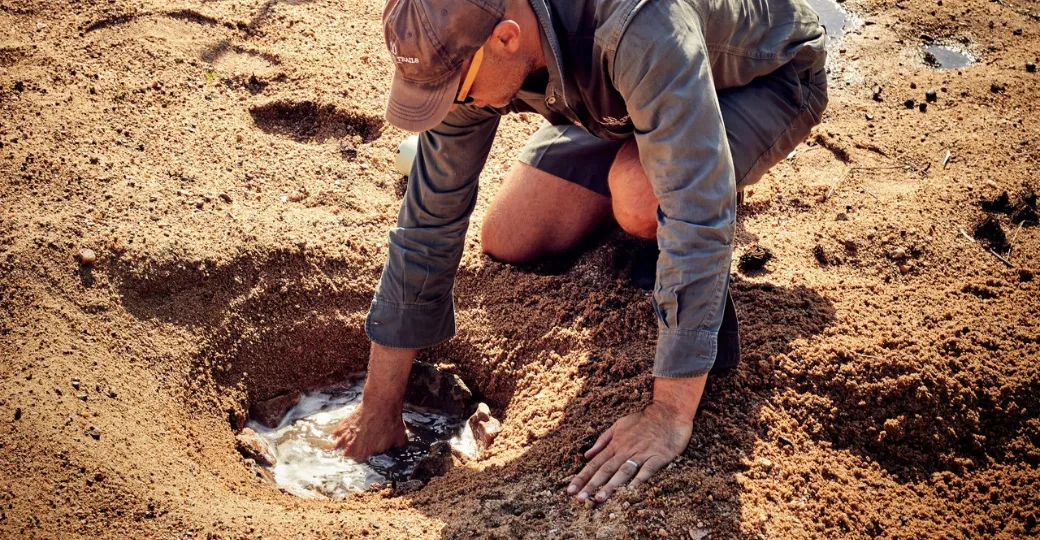
The riverbed looked bone dry, until we dug. Moments later, crystal-clear water bubbled up through the sand.
Bottles filled, we walked. Single file, in silence. We walked until Brenden declared we didn't. This so happened to be in a Mopane clearing that was to be our campsite for the night.
Camping is easy when there's no convoluted instruction manual for the tent poles or an argument over who left the pegs at home. One ground sheet was laid out, on top of that a bivvy bag, inside of which we put our mattress and sleeping bag.
Once the dehydrated chicken curry was rehydrated, and a "shower" from my water bottle had freshened me up, it was time to settle in for our first evening under the majestic canopy of stars.
The Night's Watch
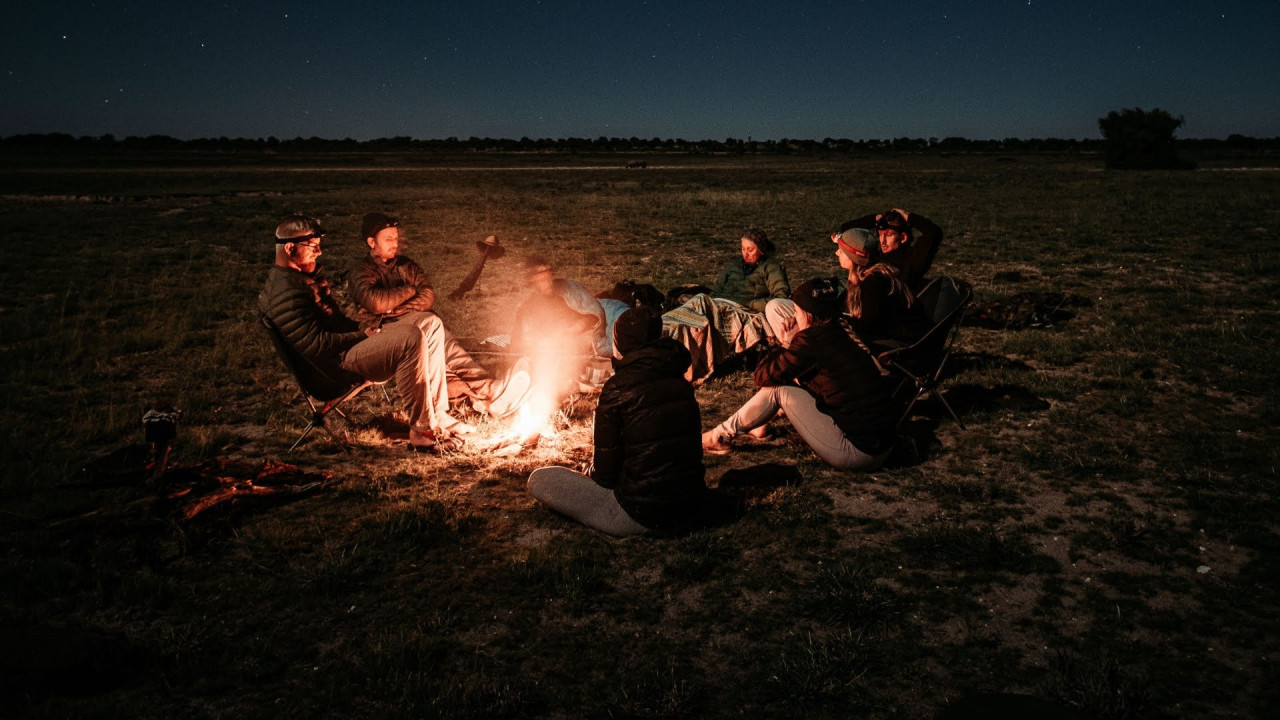
As darkness fell, a fire was lit, kept purposefully small as its sole intention was company, not heat nor safety, and we are bound by nature to leave zero trace.
Conversation around the fire naturally led to what lay ahead. Three days of walking, with no agenda, no destination, no intentions.
Brenden encouraged us to all consider our own purpose, to look inwards at what we wanted to experience. It made me look at this experience very differently to my expectations before arriving. This was going to be a journey through the wilderness in search of connection to oneself and the environment.
With the fire talk winding down, it was time to bed down. But it wasn't going to be a full night's sleep for anyone, as we took it in turns to be on watch. Roughly an hour each, but what is an hour when you have no way of telling the time?
As we climbed into our sleeping bags, two lions were calling to each other in the distance. Far enough away not to worry about, but loud enough for us all to know they were there.
I was on third watch that first night, so my best guess is that it was about midnight. The purpose of watch is simple: keep the fire alight and occasionally scan for visitors. All was quiet, but your senses become extraordinarily heightened when you are the only human awake for miles around, every leaf rustle was amplified. That first watch was a little anxiety-led, but over the next two nights we all grew comfortable, and it became something each of us looked forward to, each hoping for an encounter of sorts.
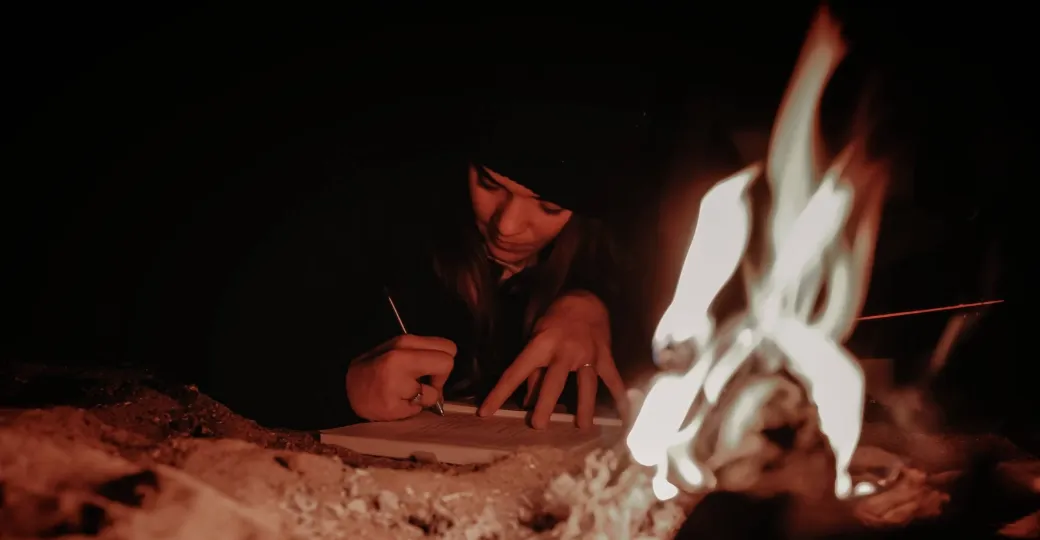
With no sense of time and nowhere to be, the journal pages filled themselves.
The Sound of Silence
We woke with the sun on our first morning with hushed tones and calm movements. We were all relaxing into our wilderness experience, or perhaps the wilderness was taking us over. Probably both. When there is nothing but you and the bush, life takes on a different pace.
The first task of the day was to find more water, so we packed up our kit and headed for the apparently dry riverbed, dug a hole and hey presto...
With bottles filled, we fell in behind Brenden and ambled off through the bush. For the next two and a half days, that was our routine and our purpose: walk to water. With every step, we disconnected a little further from the wider world. The luxury of this experience is its utter remoteness, the silence and the vulnerability.
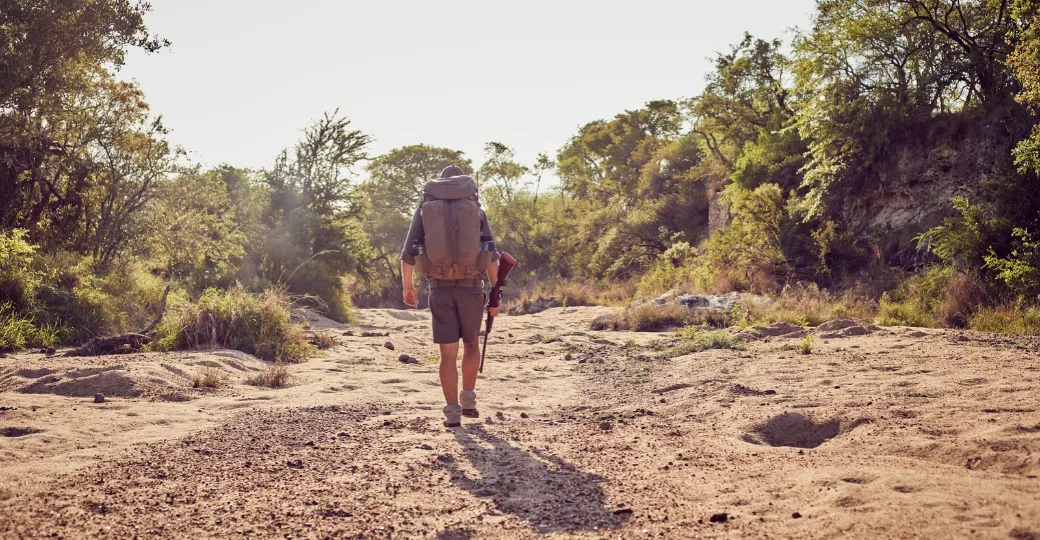
Following Brenden to water. Just beneath the sand lies everything you need.
During the hours on foot, Brenden shared some vital lessons of the wilderness, as taught by Dr Ian McCallum – wilderness guide, poet and former Springbok rugby player:
Be awake, be alert, be aware.
See before you are seen, hear before you are heard.
Assume nothing, expect anything.
Never underestimate the other.
Avoid unnecessary conflict.
But when drawn into conflict, know exactly what you are defending.
Be kind.
Over the course of calm conversation, it became clear that these lessons aren't limited to the wilderness. They apply just as much to "real life", learnings I didn't anticipate, yet took away from the primitive trail.
When the sun got too hot, we settled in the shade of a tree and shared some rehydrated lunch goodies (dehydrated hummus is delicious – I highly recommend it!). We laid out our ground sheets, snoozed, chatted, journaled, and I started writing this blog. We may have sat there for four or five hours, but without a time-telling device, who knows? All we knew was that once the heat dropped enough to enjoy walking again, off we set to find more water and a spot to call camp for the night.
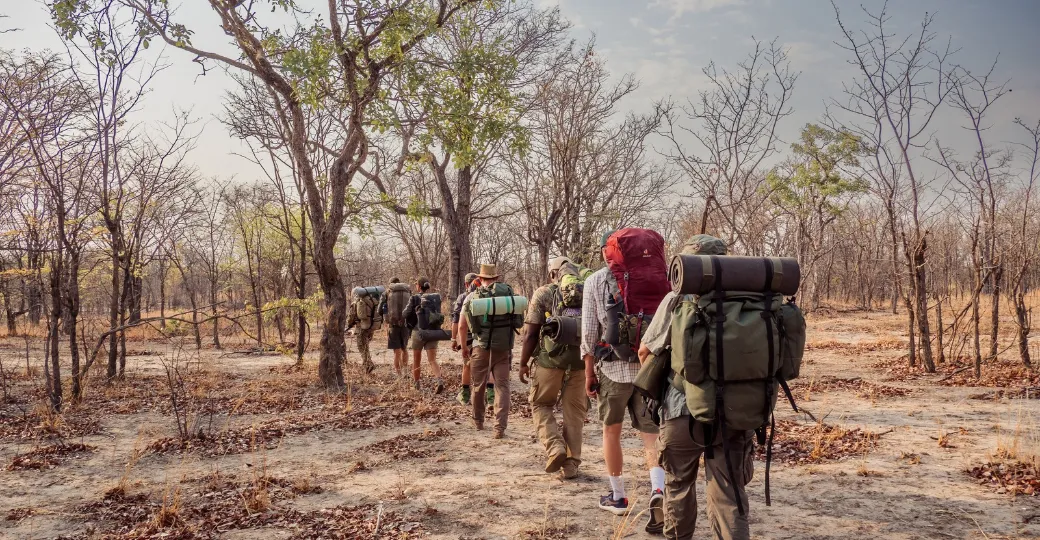
No destination, no agenda. Just the next step, and the next waterhole.
Walking through this wilderness area is not about spotting lots of game, although we did meet some lovely characters, more intrigued by us than we were by them: impala, bushbuck, waterbuck, and plenty of Sharpe's grysbok scooting away through the bush. I soon came to realise that game viewing is not what this trail is about; the wildlife is a bonus. Yet the evidence of animal activity was everywhere – buffalo and elephant droppings, lion and hyena tracks in the sand, and a beautiful honeyguide chattering to us from the treetops each morning.
As the group got to know each other, our conversations changed, and we found more solace in silence. There was a quiet respect among us for each individual's journey, and watching those emotions emerge in my fellow trail walkers was a privilege.
On a primitive trail, your attention shifts. I noticed my mind stopped asking questions of me; thoughts simply rolled through without demanding consideration. The world grew quieter, and the hum of everyday reality became nothing but a distant thought. Mental silence like this is rare, grounding and truly special.
As our time on foot drew to a close, I could feel a hesitation to return to "reality". Thankfully, we weren't thrust straight back into the world; we eased back in with two more nights at the bush camp. Our devices were returned to us, but, other than a quick message to confirm my existence to anyone who might have been wondering, my phone stayed off and my watch stayed in my bag. I adopted the approach that if someone needs me to be somewhere, they'll find me, and any social media posts bragging about being in the bush could wait. It was freeing.
Some experiences are hard to explain and simply have to be lived. This is one of them.
This trail is not for everyone, but it will leave an indelible mark on anyone who ventures along it. You will have to find the words to tell the world how you both lost and found yourself, adventuring in the wilderness.
If you’d like to trade your phone for a bivvy bag and a sky full of stars, reach out to your friends at Bonamy and we’ll make it happen.

Vanessa Beldam
Ness first landed in Africa in 2008, when on a whim she accepted a job working in a safari camp in Zambia’s South Luangwa National Park. Little did she know how deep an effect this would have on he...
View profileNever miss a notebook entry with our newsletter